


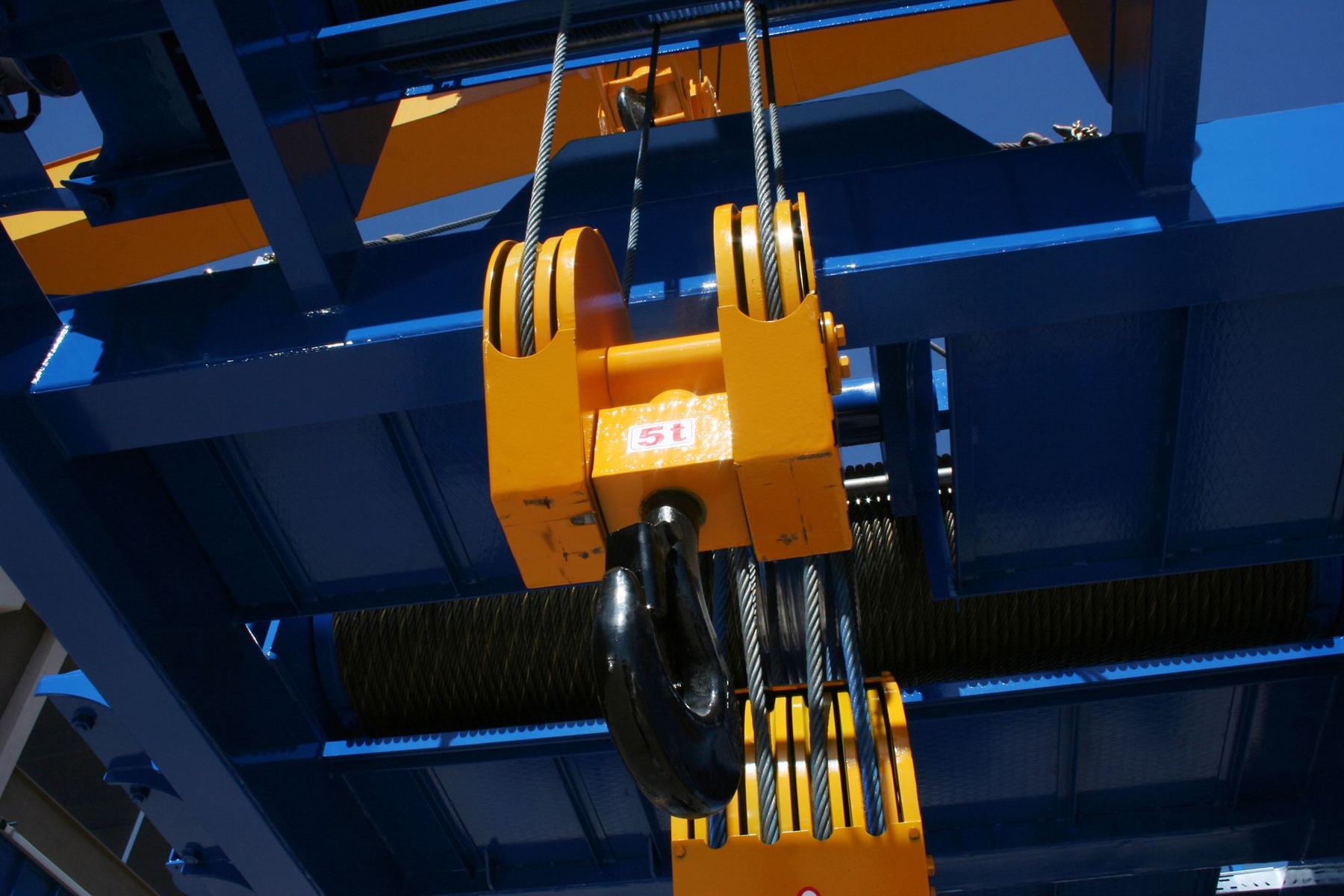
Electric Wire Rope Hoists
Compact, high-capacity hoists for single and double girder cranes, in foot-mounted, low-headroom or normal-headroom designs, supplied with new cranes or as replacements.
What is a wire rope hoist?
A wire rope hoist winds a steel rope onto a grooved drum to raise and lower the hook. It is the usual choice for higher capacities, greater lifting heights and heavier duty on overhead and gantry cranes.
Designs
| Design | How it mounts | Typical use |
|---|---|---|
| Foot-mounted | Fixed on a frame or support | Fixed lifting points and winch applications |
| Low-headroom | Runs beside and under the girder to save height | Single girder cranes in halls with limited height |
| Normal-headroom | Runs below the girder | Single girder cranes and monorails with available height |
| Open winch and crab | Open-frame unit on top of two girders | Heavy-duty double girder cranes, with main and auxiliary hoist options |
Specification
| Specification | Range |
|---|---|
| Capacity | 125 kg – 100 t (across EOTEC hoisting units) |
| Lifting height | Up to 60 m |
| Speeds | Two-speed or stepless inverter |
| Duty class | FEM 1Am – 4m / ISO M4 – M7 |
Choosing the right hoist
Start with the load, lifting height and duty. A hoist that is correctly classified for how you actually use it will last far longer than one chosen only by capacity. Our guide to FEM and ISO duty classes explains how this works, and Wire Rope or Chain Hoist? compares the two main options.
Standards and safety
Power-driven hoists are covered by EN 14492-2. EOTEC hoisting units use overload protection and long-life components, with original spare parts available to keep downtime short. We can also fit a new hoist to an existing crane as part of a modernization.
Related

Electric Chain Hoists
Light, versatile hoists for jib cranes, monorails and workstation systems.

Wire Rope or Chain Hoist? A Practical Guide
Duty class, lifting height and cost: choosing the right hoisting unit.

Double Girder Overhead Cranes
Heavy-duty bridge cranes for high capacities, long spans and maximum hook height.
Can a wire rope hoist be supplied without a crane?
Yes. Wire rope hoists, electric chain hoists and open winch units are available standalone, for new runways, monorails or to replace a hoist on an existing crane.
What lifting height can a wire rope hoist reach?
EOTEC hoisting units are available with lifting heights up to 60 m.
When should I choose a low-headroom hoist?
When the hook height under a single girder crane matters. A low-headroom design keeps the hoist close to the girder to gain usable height.
What is the difference between a foot-mounted and a normal-headroom wire rope hoist?
A foot-mounted hoist is fixed on a frame or support and lifts from one point, so it suits fixed lifting points and winch applications. A normal-headroom hoist runs below a girder or monorail and carries the load along it, where the building has height to spare. Choose by whether the hook has to travel: if it stays over one spot, foot-mounted is the simpler answer.
Which duty class does my wire rope hoist need?
It depends on how close to full load the hoist usually works and how many hours it actually runs, not on capacity alone. EOTEC hoisting units cover FEM 1Am to 4m (ISO M4 to M7). Under-specifying wears out gears, bearings, ropes and brakes early, while over-specifying costs more than necessary. Our duty class guide shows how to work it out.
How do I know when a hoist wire rope needs replacing?
Replace the rope when inspection finds broken wires, corrosion, kinks, crushing or a visible loss of diameter, judged against the hoist manufacturer's discard criteria. The rope should not be assessed alone. The drum, rope guides, hook and brake are checked at the same time, because a worn drum groove or guide will damage a new rope quickly. Use the rope specified for the hoist.
Should a wire rope hoist have two-speed or stepless inverter hoisting?
Two-speed is enough for simple lifting, where a fast speed and a slow speed cover the work. Choose a stepless inverter when loads are delicate, positioned often or placed accurately, such as in assembly, stacking or machine loading. The inverter also reduces mechanical shock on gears and brakes, which matters more as the hoist works harder through the shift.
What has to be checked before fitting a new wire rope hoist to an existing crane?
The girder comes first: it must carry the new hoist's weight and rated load, and the trolley must suit the beam's flange. Then check the hook height the new hoist gives, the wheel loads on the runway, and whether the controls and power supply match. The structure also has to be sound. EOTEC can fit a new hoist as part of a crane modernization.
