


EOT Cranes
Electric overhead travelling cranes engineered, built, installed and serviced by EOTEC in Konya, Türkiye, up to 100 t with spans up to 40 m.
What is an EOT crane?
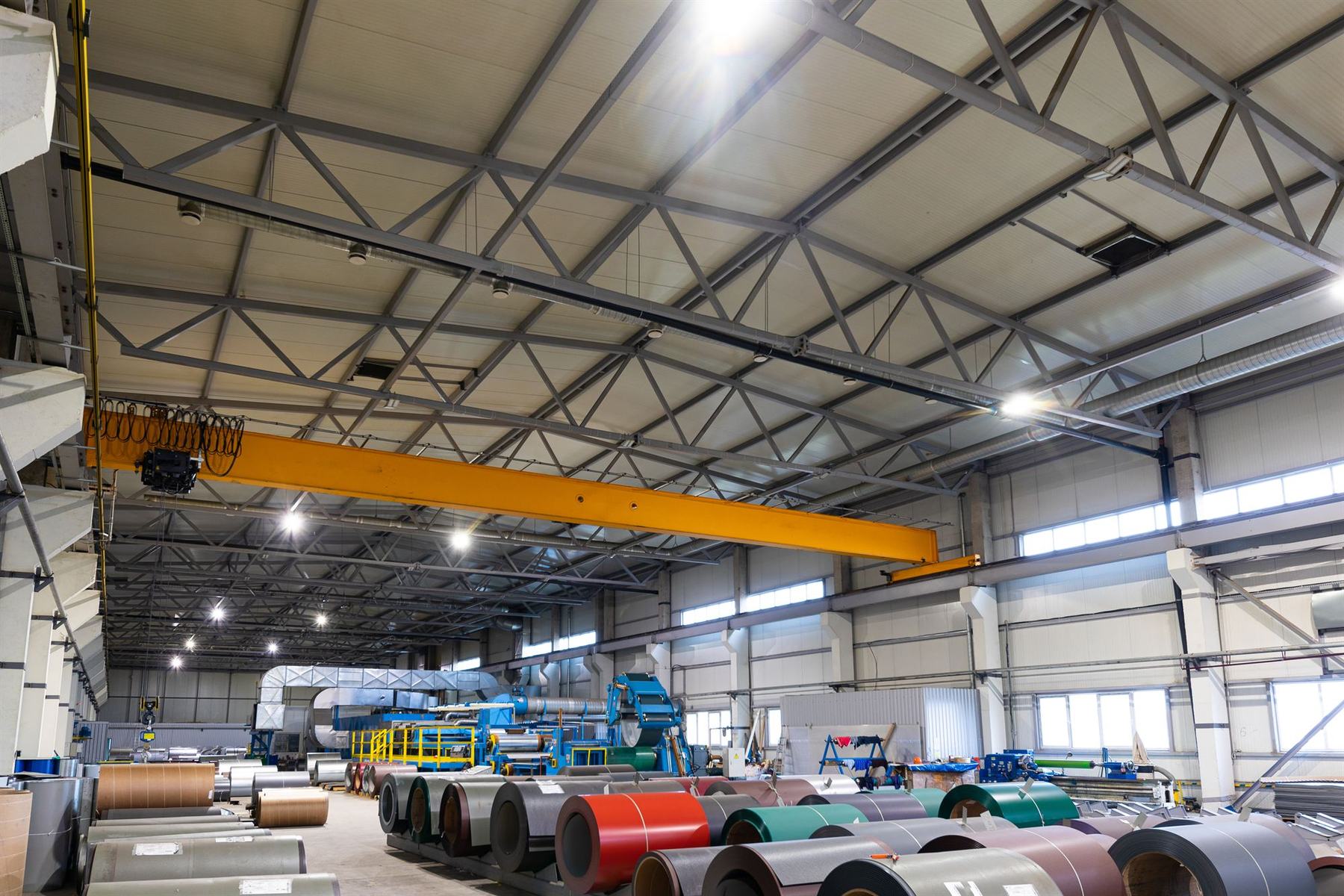
EOT stands for electric overhead travelling. An EOT crane is a bridge that travels along two elevated runway rails, with a hoist that travels across the bridge. Electric motors drive all three movements: long travel along the runway, cross travel along the bridge, and hoisting up and down. Together they let the hook reach almost any point in the working area without taking up floor space.
You will also see EOT cranes called overhead cranes, bridge cranes or overhead travelling cranes. The terms overlap. EOT simply stresses that the crane is electrically powered and travels on a runway.
Types of EOT crane
| Type | How it is built | Best suited to |
|---|---|---|
| Single girder | One main girder with the hoist running on its lower flange | Light to medium duty, lighter building loads, fast installation |
| Double girder | Two main girders with a crab running on top | Heavy loads, long spans, intensive duty and maximum hook height |
| Underslung | Wheels run on the lower flange of the runway beam | Halls where the structure or headroom rule out a top-running crane |
| Process crane | Heavy double girder design calculated for production duty | Cranes that form part of a continuous production line |
Main components
- Main girder or girders carry the load across the span.
- End carriages hold the travel wheels and motors that move the bridge along the runway.
- Hoisting unit: a wire rope hoist, electric chain hoist or open crab.
- Runway beams and rails support the crane and are often part of the building structure.
- Power supply: festoon systems and conductor rails feed the crane and the hoist.
- Controls: pendant station, radio remote or operator cabin, with two-speed or stepless inverter drives.
- Safety devices: overload limiters, limit switches, anti-collision sensors and emergency stops.
What to tell a manufacturer when specifying an EOT crane
- Safe working load: the heaviest load including any lifting attachment.
- Span: the distance between runway rail centres.
- Hook height and the clear height under the roof structure.
- Duty: how many lifts per hour, how heavy they usually are and how many hours a day the crane works. See our guide to FEM and ISO duty classes.
- Environment: indoor or outdoor, temperature, dust, humidity.
- Control and speed: pendant, radio or cabin, and how precisely loads must be positioned.
- Power supply available at the site.
Not sure about the numbers? EOTEC surveys your hall and measures the runway before recommending a crane. The survey and quotation are free of charge.
EOT cranes built by EOTEC
| Specification | EOTEC range |
|---|---|
| Capacity | Up to 100 t (higher on request) |
| Span | Up to 40 m |
| Duty class | FEM 1Am – 4m / ISO M4 – M7 |
| Control | Pendant, radio remote or cabin |
| Drives | Two-speed or stepless inverter |
| Design standards | EN 15011, EN 14492-2, FEM 9.511, ISO 4301 |
Every crane is load tested before handover and supplied with CE documentation. Typical lead time is 8–14 weeks from approved drawings to installation, depending on capacity and specification.
Related
Single Girder Overhead Cranes
Lightweight, cost-effective bridge cranes for light to medium duty.

Double Girder Overhead Cranes
Heavy-duty bridge cranes for high capacities, long spans and maximum hook height.

How to Choose an Overhead Crane: A Buyer's Guide
The seven decisions that define the right crane for your plant.
What does EOT stand for in cranes?
EOT stands for electric overhead travelling. It describes a crane whose bridge travels on elevated runway rails, with electric motors driving the bridge, the hoist trolley and the hoist.
Is an EOT crane the same as an overhead crane?
In most cases yes. EOT crane, overhead crane and bridge crane usually describe the same type of machine, a bridge travelling on a runway, though overhead crane is the broader term.
What capacity can an EOT crane lift?
EOTEC EOT cranes cover safe working loads from 0.5 t to 100 t, with larger capacities and special designs engineered on request.
How long does an EOT crane project take?
Typical lead time is 8–14 weeks from approved drawings to installation, depending on capacity and specification. Installation on site usually takes a few days.
What are long travel and cross travel on an EOT crane?
Long travel is the whole bridge moving along the runway, and cross travel is the hoist trolley moving along the bridge. With hoisting, these are the three motions of an EOT crane, all driven by electric motors. Together they let the hook reach almost any point in the hall. The motions can be controlled with two-speed or stepless inverter drives.
Can an EOT crane be installed in an existing building?
Yes, if the structure can carry the crane. Runway beams and rails are often part of the building, so the columns and beams must take the crane's wheel loads, and the clear height must leave room for the hook height you need. Where the structure or headroom rules out a top-running crane, an underslung design may fit. EOTEC surveys the hall and measures the runway before recommending a crane.
How is the span of an EOT crane measured?
Span is the distance between the centres of the runway rails, not the width of the hall between walls. The figure matters because the girder is calculated on it, and a small error means a crane that does not fit the rails. EOTEC builds EOT cranes with spans up to 40 m. If there is no runway yet, send us the hall drawings and column positions.
Should an EOT crane be controlled by pendant, radio remote or cabin?
A pendant suits simple, occasional lifting where the operator can walk safely with the load. A radio remote lets the operator choose a safer position with a clearer view, away from the load. A cabin suits cranes in use for long periods, or where the operator cannot see the load well from the floor. The working routine and the layout of the floor usually settle it.
